Small Appliances Manufacturer

From 10 opinions to one system: an agentic platform replaced subjective listing assessments with a data-driven methodology across 3,500+ SKUs in 6.5 weeks

An international group with a portfolio of six small appliance brands and ~3,500 SKUs across three marketplaces replaced subjective visual assessments ("10 people — 10 opinions") with a data-driven methodology inside an isolated infrastructure perimeter.

Impact Scale to thousands of SKUs; audit cycle reduced from weeks to one day
Industry
Small Appliances / FMCG / E-commerce
Duration
Audit 2 wks · development & integration 4.5 wks · retainer
24TTL team
Project Manager, Senior Consultant, AI Architect, ML Engineer, Backend Developer, DevOps, QA
All cases →
9 specialized AI agents in production
6.5 weeks from kickoff to deployment
Thousands of SKUs — scaling potential
Audit cycle: weeks → one day

Context

~3,500 SKUs in the "premium-mass" niche are distributed via Ozon, Wildberries, and Yandex Market. A new Head of Commercial Content and e-commerce marketing and SEO/GEO teams initiated a review of the listing management approach.

The "audit tool" request grew into a fully-fledged agentic system during scoping — a continuously running AI loop inside the client's perimeter that aggregates data, generates insights, and raises alerts without human involvement in routine tasks.

Challenge

Content management was built on expert opinions, and those opinions systematically diverged: "if you seat 10 people at a listing, you'll get 10 different opinions." Visual revisions went through 4–5 functions; approving a single carousel took 3–4 weeks, with no arguments to present to management. There was no alignment between SEO semantics, U&A research, and design.

Audits were done in isolation — 3–5 SKUs in Excel; competitors were analyzed quarterly, and reaction to their changes lagged by 4+ weeks. Cross-marketplace content consistency checks were done by eye. The top of search results was treated as the benchmark, ignoring the price index, stock levels, and performance budgets.

Project goals

What the AI did

9 specialized AI agents replace subjective listing evaluation with a data-driven methodology: audit, competitive benchmarking, SEO, and compliance — all within an isolated environment.

01

9 agents instead of 10 opinions

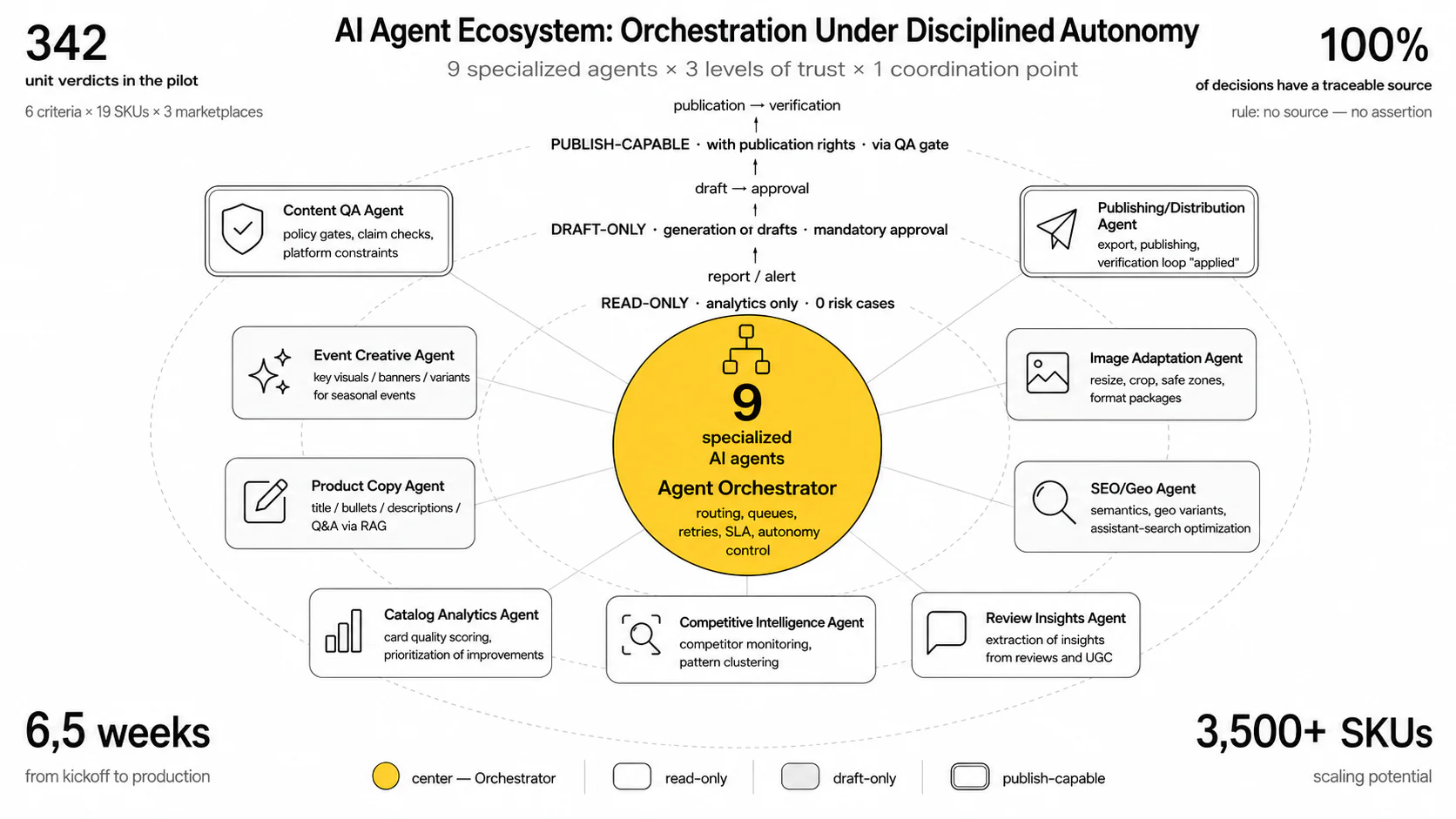
The reasoning layer is split into 9 specialized agents (Creative, Copy, SEO/GEO, QA, Analytics, Competitive, Publishing, and others) with autonomy policies ranging from "read-only" to "with publication rights." The orchestrator assembles verdicts into a report: 6 criteria × 19 SKUs × 3 marketplaces = 342 verdicts, each with a 3–5 sentence rationale and source reference.
02

RAG loop with citation — "no source, no claim"

The knowledge base holds brand guides, platform rules, NDA-protected U&A, and semantics across 6 categories. Each agent is required to cite a source; rule versions are preserved to reproduce any past decision. This resolved the core compliance concern — confidential research is used without leaving the perimeter.

03

Competitive benchmark via clustering

A Competitive Intelligence Agent with a virtual browser collects ~130 competitor listings in the same price segment; multi-modal CV converts each into a vector and clusters them in 1024-dimensional space, identifying the dominant category pattern. This removes the "top of search = benchmark" trap.

04

Brand context layer and predictive CTR

Assessment is made not relative to the entire market, but relative to the "brand × category × segment" intersection: positioning, buyer profile from U&A, brand guides. Simulated eye-tracking and attention maps provide a predictive before/after CTR estimate — an A/B test before the A/B test.

Agentic Content Audit — 9 specialised agents
9 specialised agents
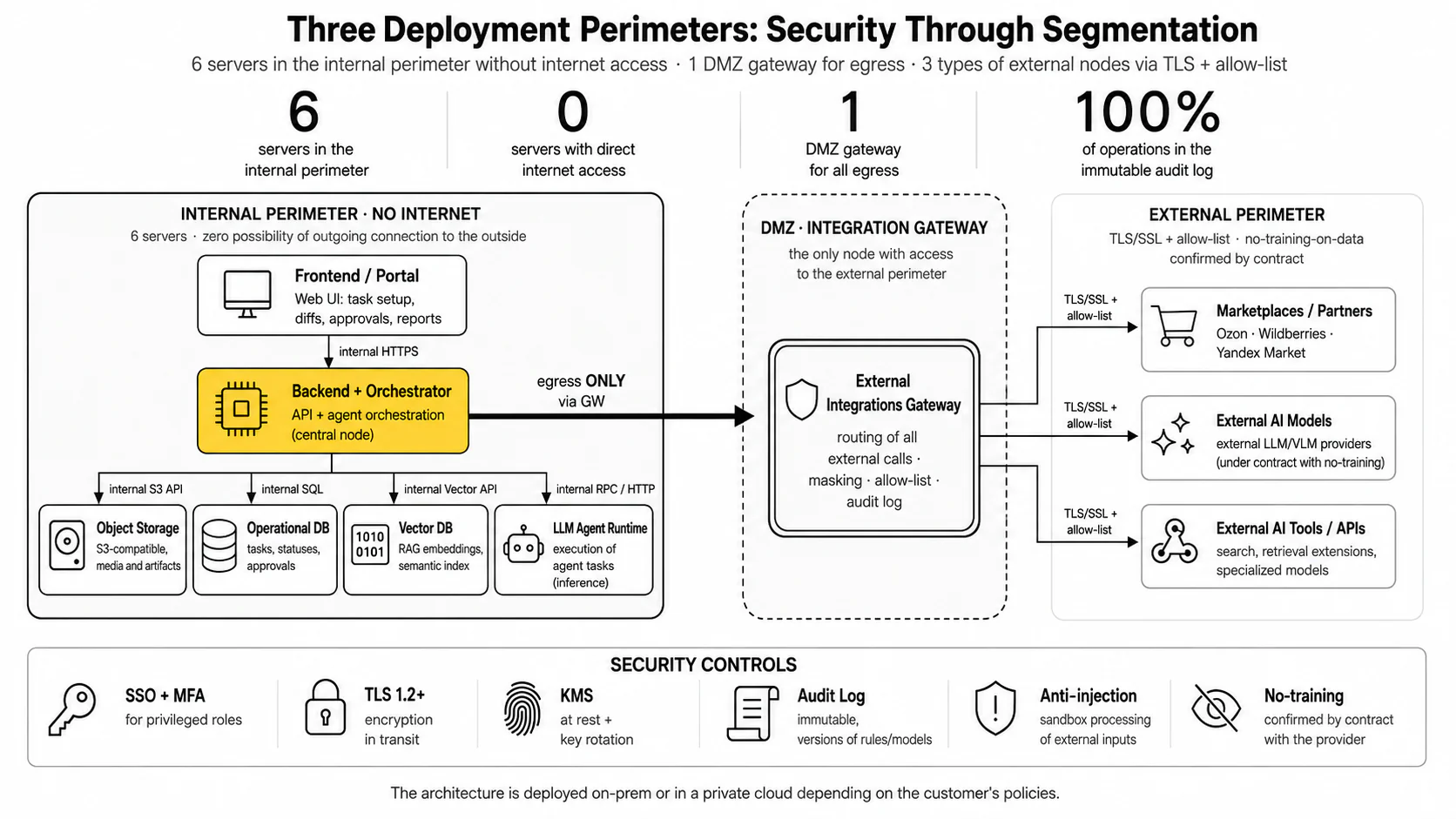
Agentic Content Audit — Security contours
Security contours

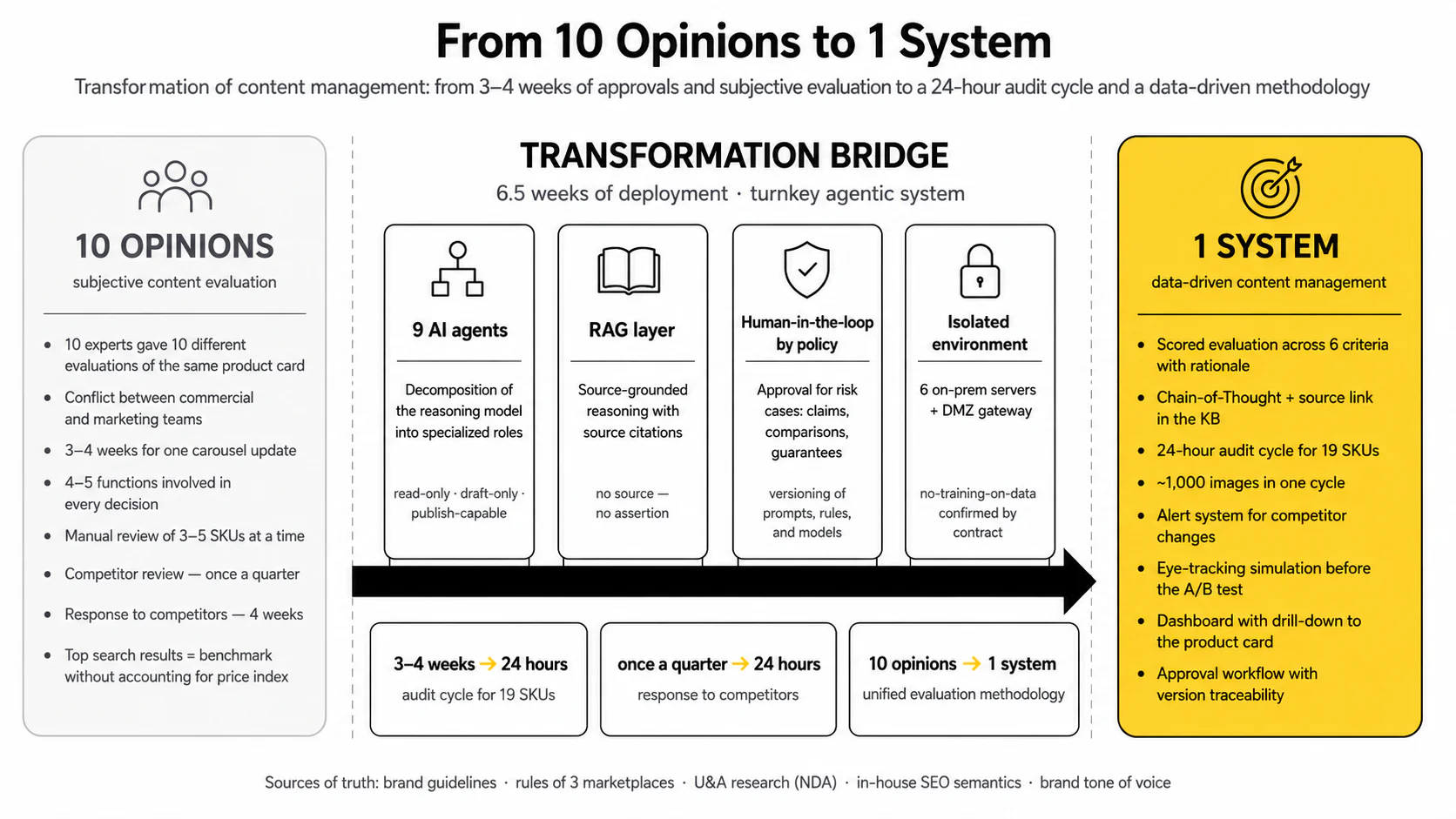
Before and after

Before — manual
  • ×10 experts gave 10 different assessments of the same listing
  • ×Conflict between commercial and marketing teams on visuals
  • ×Manual review in Excel — 3–5 SKUs at a time
  • ×Competitors analyzed quarterly, 1–2 listings at a time
  • ×Reaction to competitor changes — a month later
  • ×Consistency across Ozon / WB / Yandex Market — checked by eye
  • ×Top of search treated as benchmark without accounting for price index
Now — AI agent
  • Score-based assessment on 6 criteria with rationale for each listing
  • Chain-of-Thought reasoning chain for each recommendation
  • Automated screenshot collection from 3 marketplaces simultaneously
  • Clustering ~130 competitor listings in 1024-dimensional space
  • Eye-tracking simulation and attention maps before and after
  • Alerts when competitor content changes
  • Source citation for every claim; structured approval process
Agentic Content Audit — Before and after
Before and after

Results

Technical metrics
  • 9 AI agents in production under a single orchestrator
  • 6 internal perimeter servers + 1 DMZ gateway
  • 3 marketplaces in a single view; ~1,000 images per pilot cycle
  • 100% of decisions with traceable source in the knowledge base
Business metrics
  • 6.5 weeks to production vs. 3–4 months for classical bespoke development
  • Audit cycle for a batch of 19 SKUs: 3–4 weeks → 24 hours
  • Reaction to competitor changes: 4 weeks → 24 hours
  • Projected CTR improvement per model; significant working-time savings at 3,500 SKUs
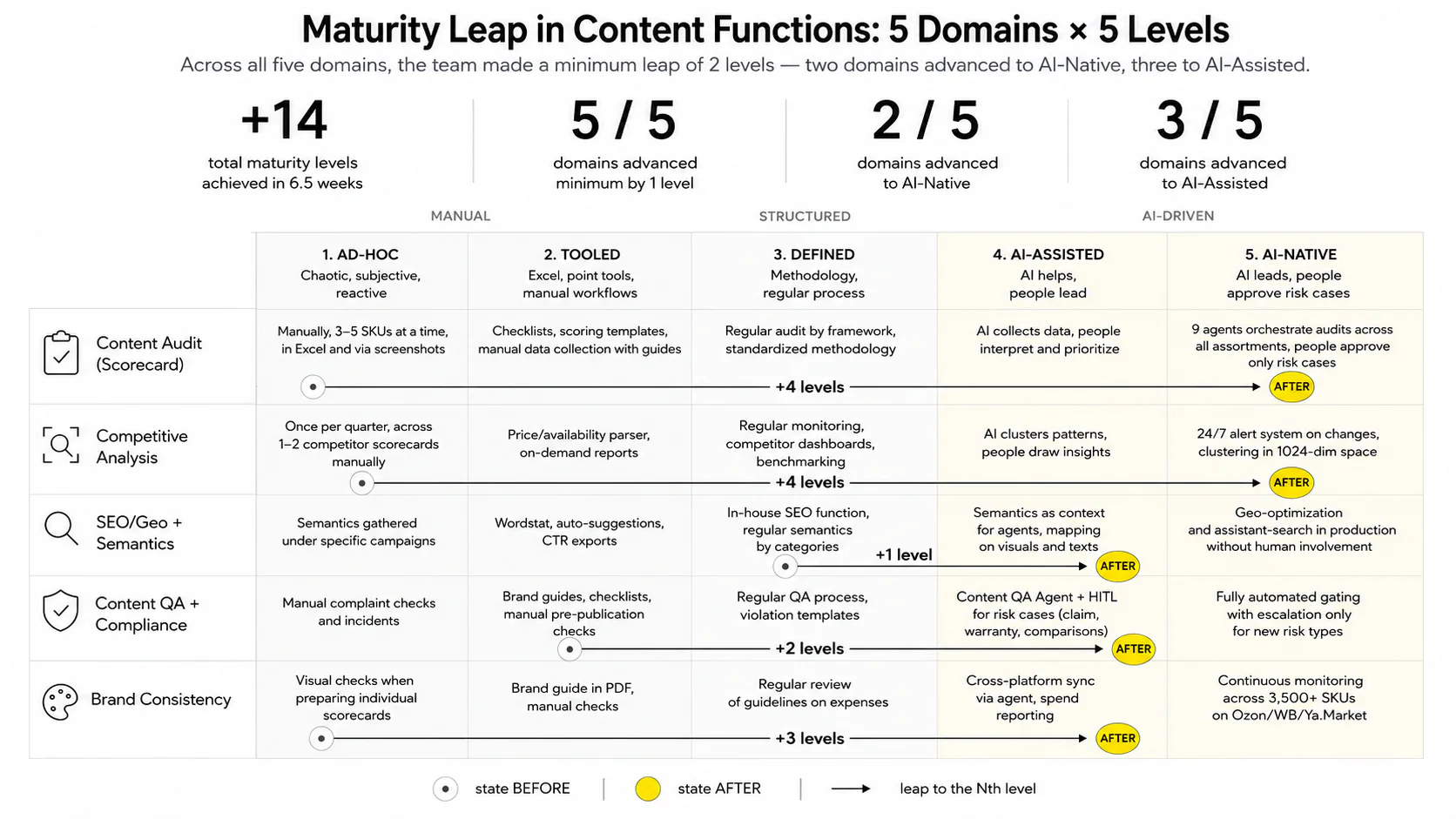
Agentic Content Audit — Maturity matrix
Maturity matrix
Strategic impact

The team received infrastructure that removes the blocking conflict between functions: instead of exchanging opinions, there is a shared data-driven foundation that can be shown to management and approved without debates about taste.

This unblocked the transition from one-off audits to daily monitoring of the full assortment and laid the groundwork for retail media, supply chain analytics, and review and VoC analytics — adding a new agent or connector takes hours, not weeks.

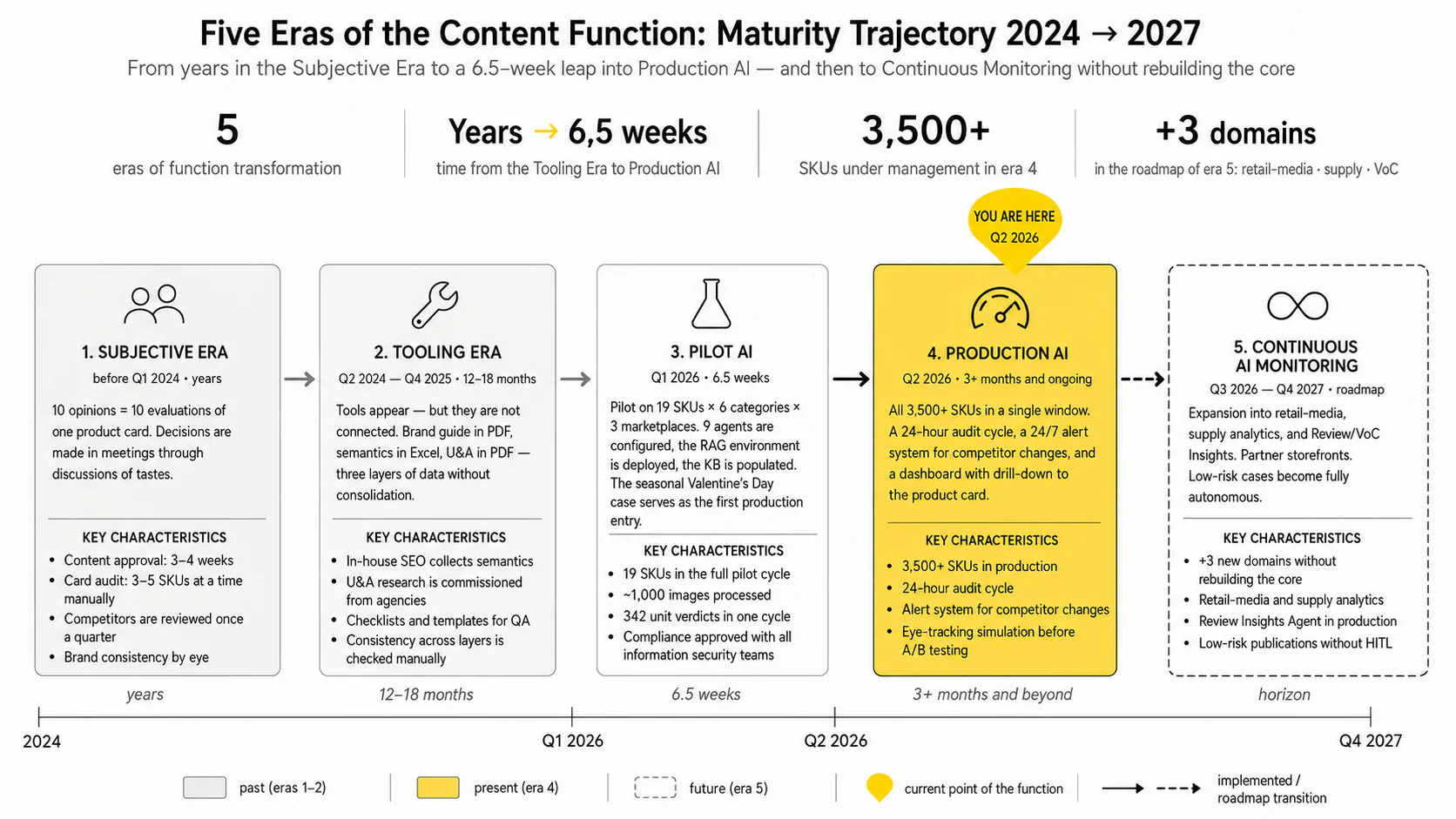
Agentic Content Audit — Development epochs
Development epochs
Now we know exactly what to change on each listing and why — with a rationale, a reference to a source in our own knowledge base, and a predictive impact estimate. Before, 10 people gave 10 opinions; now we have one system with transparent logic that can be shown to management.
— Head of Commercial Content, international small appliances manufacturer

The metrics and results presented reflect outcomes of a specific project and depend on its initial conditions. They are provided for informational purposes only, do not constitute a public offer, and do not guarantee similar results in other projects. Supporting materials are available on request.

Other cases

Facing a similar challenge?

Tell us about your process — we will suggest an audit, pilot, or full deployment.