Major Fashion Marketplace

AI audit of 150,000 SKUs: how a browser agent replaced manual size-chart verification against brand websites

One of the leading fashion marketplaces with a catalog of 650,000+ SKUs and a flow of 100,000+ new arrivals per month checks size charts against brand official websites. Manual verification of a single SKU took 8–12 minutes — a browser agent scaled the task to the entire catalog.

Impact Hundreds of thousands of SKUs verified, high auto-verification accuracy
Industry
E-commerce / Fashion Retail
Duration
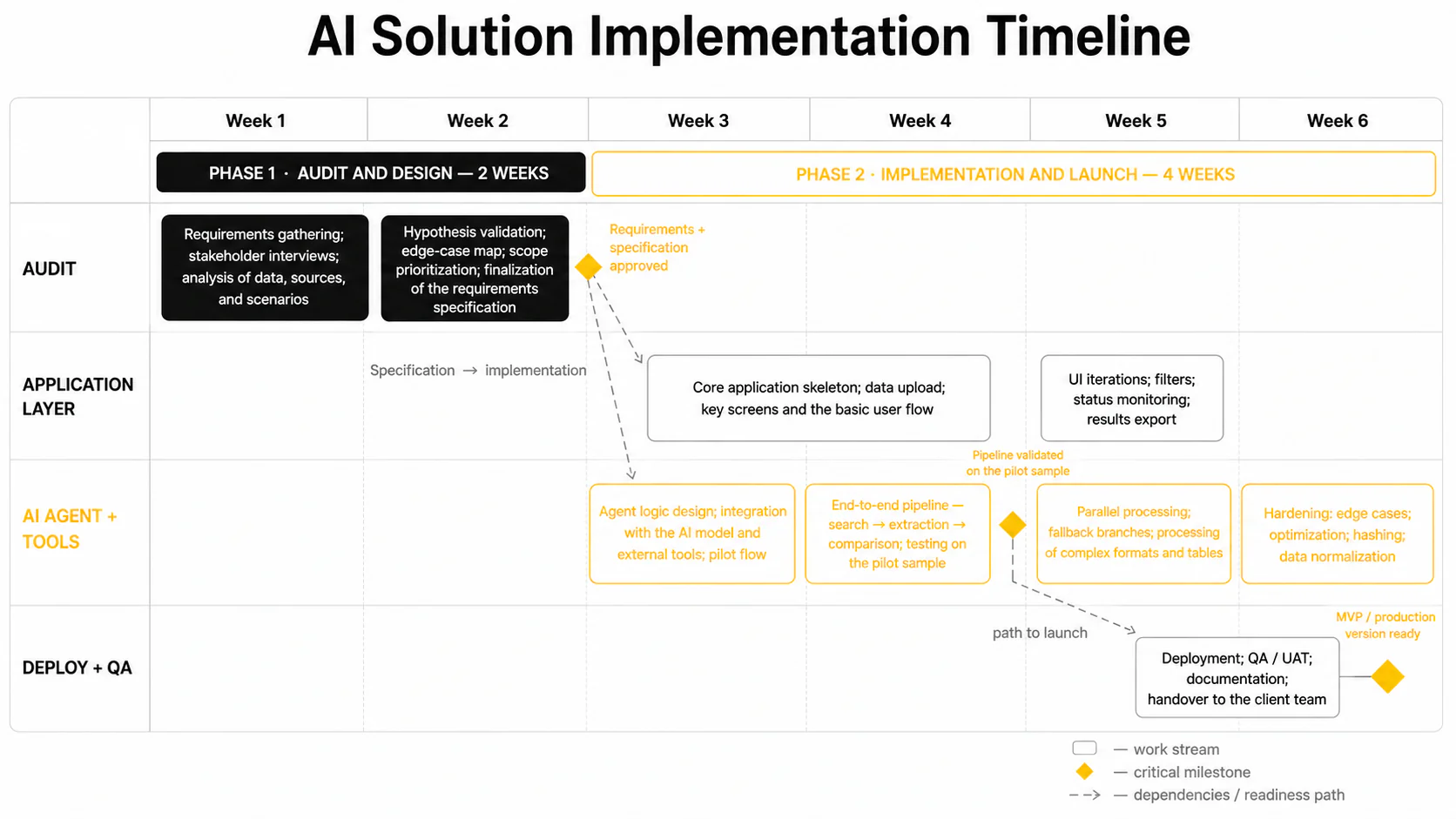
Audit 2 wks · development & integration 4 wks · monthly retainer
24TTL team
Project Manager, Senior Consultant, AI Engineer, Backend and Frontend Developer, Analyst / QA
All cases →
Hundreds of thousands of SKUs verified by AI agent
High accuracy (improves further with data standardization)
Hundreds of SKUs per single run
Majority of brands handled fully automatically

Context

Category managers and the content team are responsible for the accuracy of all product attributes, including size charts — a key parameter that directly affects returns, conversion, and customer satisfaction.

Spot checks confirmed the hypothesis: size charts on listings frequently diverge from what the brand specifies on its own website. Suppliers provide data in different formats, errors accumulate over years, and manual verification at catalog scale is physically impossible.

Challenge

Discrepancies lead directly to returns. In the pilot sample, a top brand's size M on the platform was listed as "bust circumference 88–92 cm," while the brand's website showed "90–94 cm"; a global footwear brand was missing foot-length fields that were present on its website. Each case is a potential return and negative experience.

Manual verification of a single SKU took 8–12 minutes: find the website, find the listing by supplier article number, open the table, compare dozens of fields. For 150,000 SKUs, that is approximately 25,000 person-hours. There was no systematic verification — responses were reactive, based on complaints.

Project goals

What the AI did

A browser agent cross-checks size charts in product listings against official brand websites: auto-search, Vision-based table extraction, and size system normalization.

01

Automatic search for the official brand website

Using the brand name and supplier article number, the agent queries the Serper Google API and, based on signals (domain, content, catalog), autonomously selects the official website, caching the result — one brand = one search for the entire batch. Most brands are matched automatically; the rest are re-verified on Wildberries with the source flagged.
02

Virtual browser bypasses JS rendering and bot protection

Built on browser-use Cloud with proxy rotation, the agent behaves like a real user: opens a listing, clicks a size, expands the table, scrolls. Parsing does not depend on the specific frontend of the site — even a CMS change does not break verification, and proxies provide access to international sites.

03

Parallel processing of 1,000+ SKUs per run

The async FastAPI + asyncio architecture launches thousands of virtual browsers in parallel; grouping by short_sku and caching by brand reduce the operation count by orders of magnitude. Scheduled overnight runs deliver the report by morning.

04

Claude Vision for image-based tables

When a brand website is inaccessible, the agent falls back to Wildberries, where size charts are often published as images. Claude Vision extracts measurements, sizes, and units from a screenshot with the same accuracy as from HTML — the non-standard case is handled completely.

05

Web application with SSE streaming

A React interface with drag-and-drop Excel upload, real-time progress via Server-Sent Events, color-coded status (ok / error / not found), filters, and .xlsx export with source links. Category managers work independently without IT involvement.

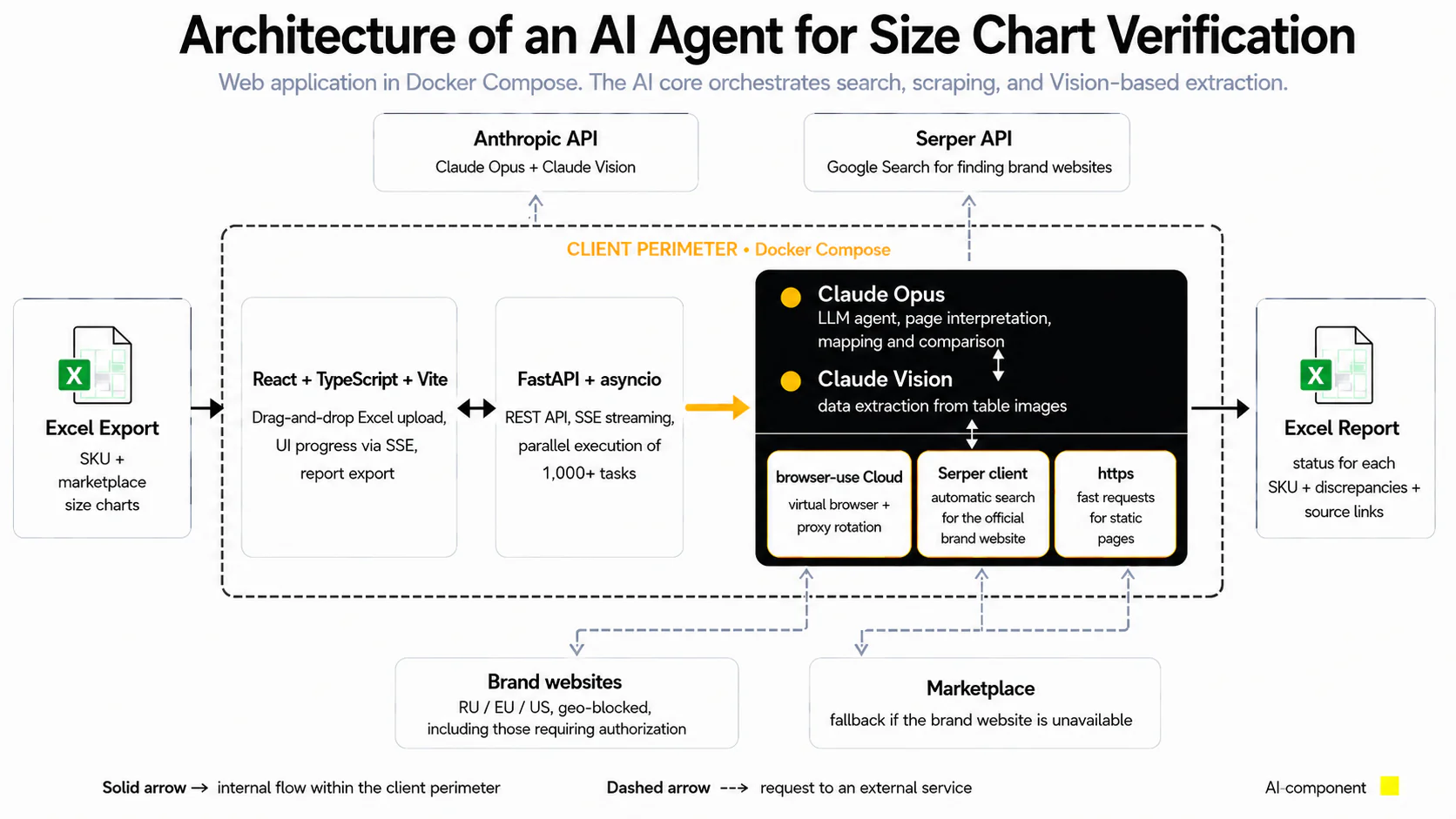
AI Size Chart Verification — Solution architecture
Solution architecture
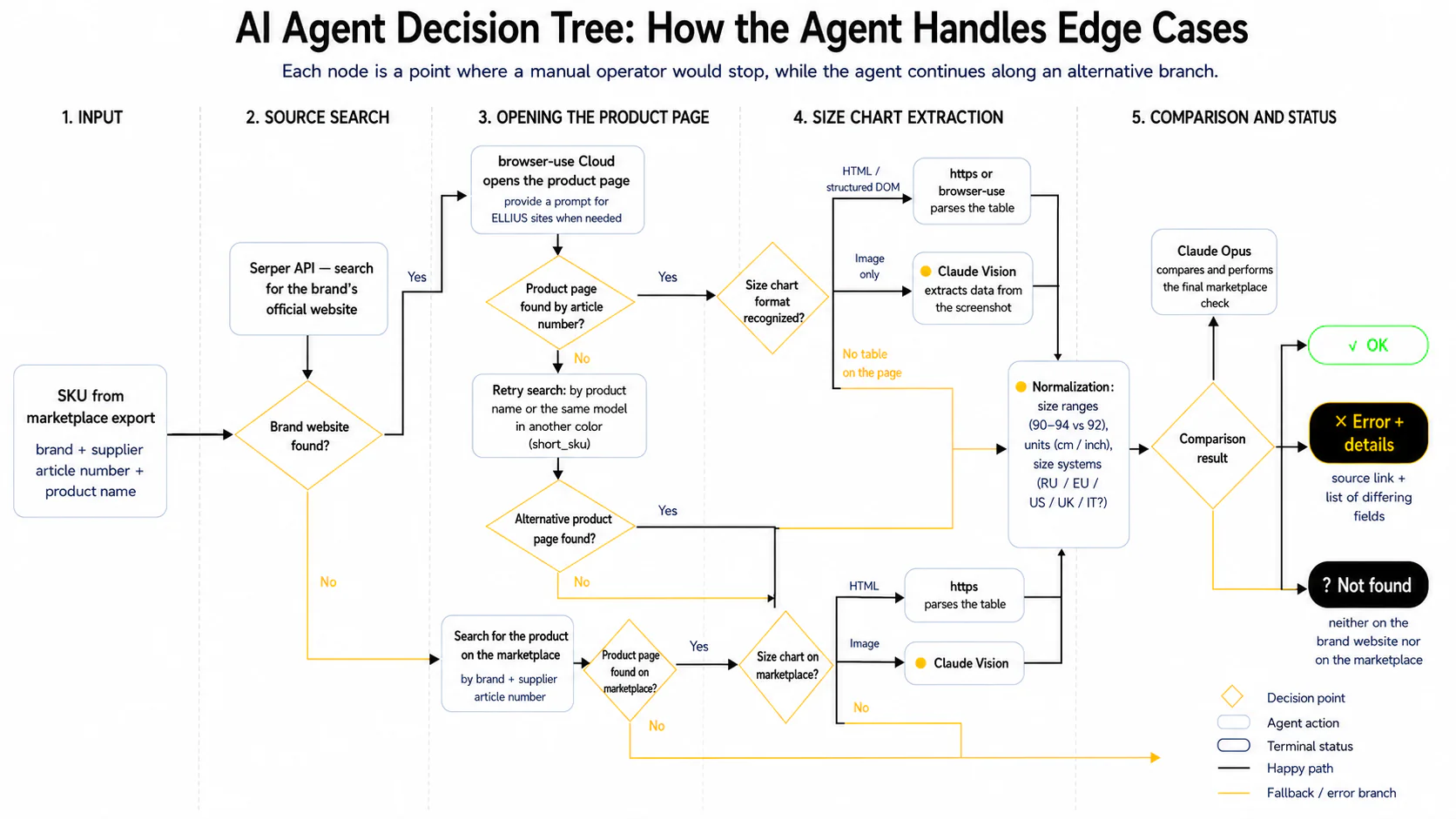
AI Size Chart Verification — Decision logic
Decision logic

Before and after

Before — manual
  • ×No systematic size-chart verification existed
  • ×8–12 minutes of operator time per SKU
  • ×Individual SKUs checked manually
  • ×Reacted to customer complaints after the fact
  • ×Bot-protected sites could not be accessed
  • ×Image-based tables and out-of-stock items were not processed
Now — AI agent
  • Automatically finds the official brand website by article number
  • Verifies in seconds, acting as a browser user
  • Processes 1,000+ SKUs in parallel per run
  • Detects discrepancies on the day the product arrives
  • Bypasses bot protection via proxy rotation
  • Reads image-based tables with computer vision and flags the source

Results

Technical metrics
  • High verification accuracy relative to manual audit; near-reference values achieved in specific projects with standardized exports
  • High brand coverage automatically, full coverage with Wildberries fallback
  • Throughput: 1,000+ SKUs per run, scalable to thousands of browsers
  • Covered: JS pages, bot protection, image-based tables, out-of-stock items
Business metrics
  • Manual verification of 150,000 SKUs (~25,000 person-hours) eliminated
  • Regular check of 100,000 new SKUs/month embedded in the process
  • Discrepancies visible on arrival day, not after complaints
  • Managers work independently, without IT escalations
Strategic impact

Size charts transformed from a "blind spot" into a verifiable catalog asset.

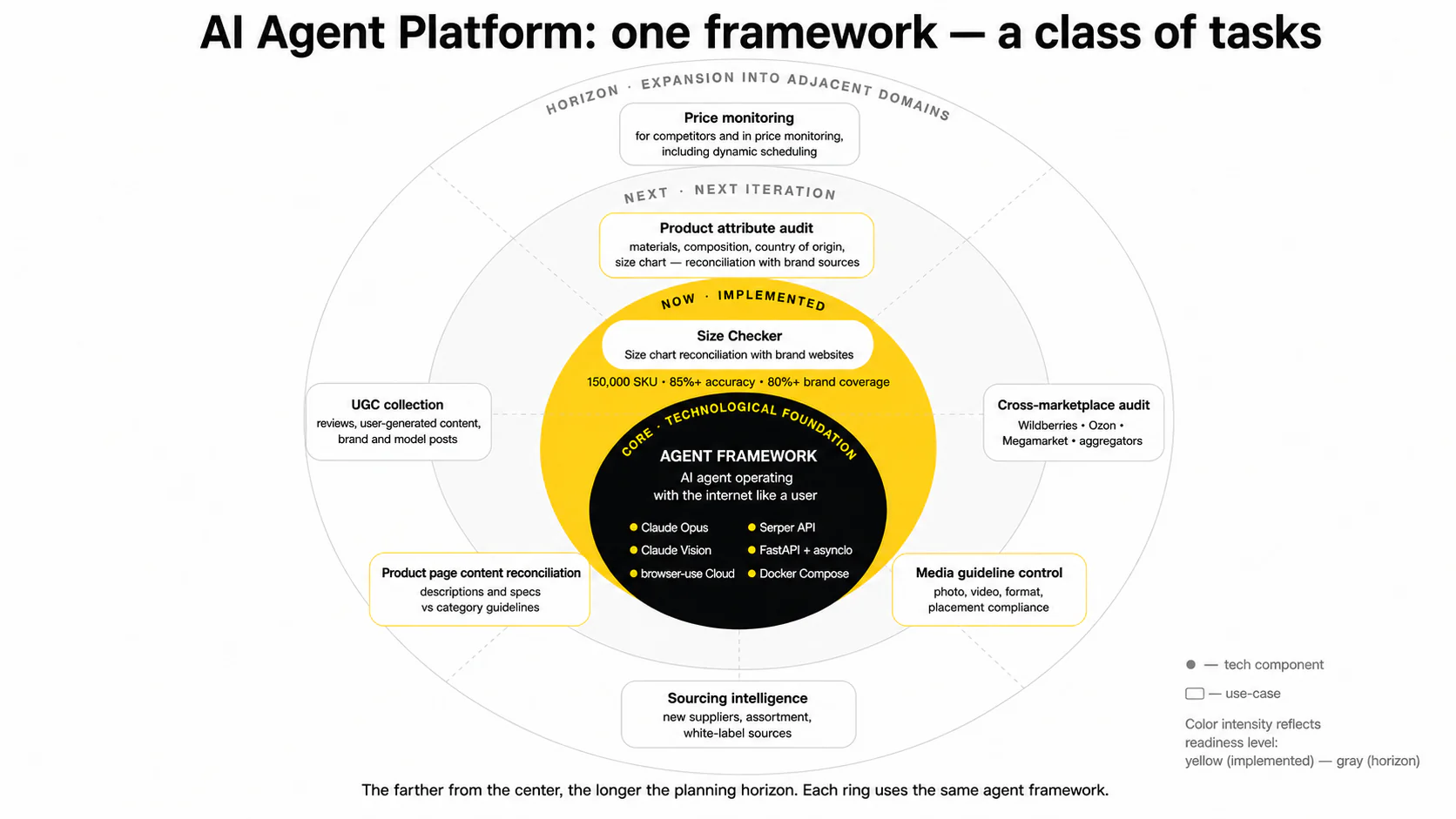
The agent framework is reusable beyond the original task — product attribute verification, competitor price monitoring, UGC collection, working with any source without an API. The solution becomes a platform of the class "AI agent operates on the web like a user."

AI Size Chart Verification — Project timeline
Project timeline
AI Size Chart Verification — Platform horizon
Platform horizon
Previously, we saw size discrepancies through returns — months after a listing went live. Now we see them on the day the product arrives. The category team uses the tool on its own, without IT, on a daily basis.
— Category team, fashion marketplace

The metrics and results presented reflect outcomes of a specific project and depend on its initial conditions. They are provided for informational purposes only, do not constitute a public offer, and do not guarantee similar results in other projects. Supporting materials are available on request.

Other cases

Facing a similar challenge?

Tell us about your process — we will suggest an audit, pilot, or full deployment.