Major E-Grocery Operator

How an AI pipeline prepares thousands of product photos per month and freed up a significant share of the content team's manual work

A leading e-grocery player with its own dark stores is pivoting from the premium segment to the mass market. Manual photo processing in Photoshop to meet a unified standard became the bottleneck for assortment onboarding.

Impact Significant manual labor freed up; substantial reduction in per-listing processing time
Industry
E-grocery / Online retail
Duration
Audit 2 wks · MVP development & integration 2 wks · retainer
24TTL team
Project Manager, Solutions Architect, AI Engineer, Backend and Frontend Developer
All cases →
Significant volume of manual labor freed up per month
Substantial reduction in per-listing time (minutes → seconds)
+6,000 SKUs through the AI pipeline during seasonal peaks
4 weeks from pilot to production MVP

Context

The client is part of a large fintech ecosystem, with proprietary dark stores and logistics. A strategic pivot from premium to the mass market is accelerating category launches and catalog rotation.

The in-house photo standard requires a consistent look (grey background #F5F5F5, 10% inset from edge, studio shadow, front-facing angle, different rules per category). Volume and source diversity turned compliance into a bottleneck.

Challenge

The flow is 400–600 items per week (often 2 photos per item), with a peak of 820 items over 3 days before a holiday. The content team cannot keep up with new arrivals, while a backlog of thousands of outdated listings not meeting the standard accumulates in parallel.

Manual processing in Photoshop takes ~3 minutes per listing (remove background, fill #F5F5F5, align with 10% inset, add shadow, resize). Macros failed on insets. Photos arrive from 6 different sources, some being phone shots from branches without a photographer.

Project goals

What the AI did

An AI platform mass-processes product photos to a unified standard: background removal, studio shadow, cropping, and batch processing of thousands of SKUs.

01

4 AI pipelines instead of manual Photoshop

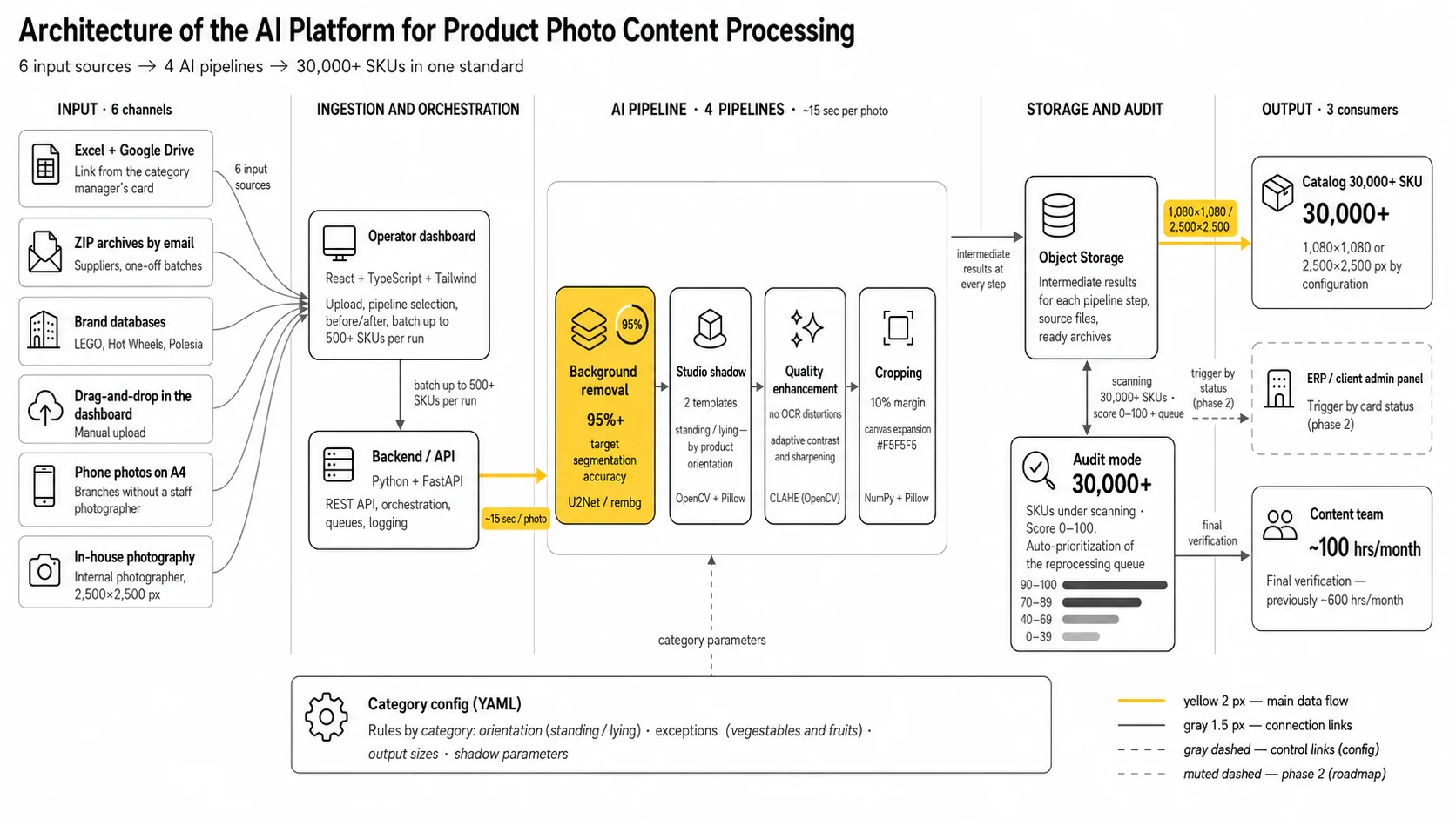
Each image passes through a chain of four modules: background removal (U2Net) → studio shadow → quality enhancement (CLAHE) → cropping. Specialized algorithms rather than a general-purpose generative model — no hallucinations or text distortion on packaging. ~15 seconds per listing instead of ~3 minutes.
02

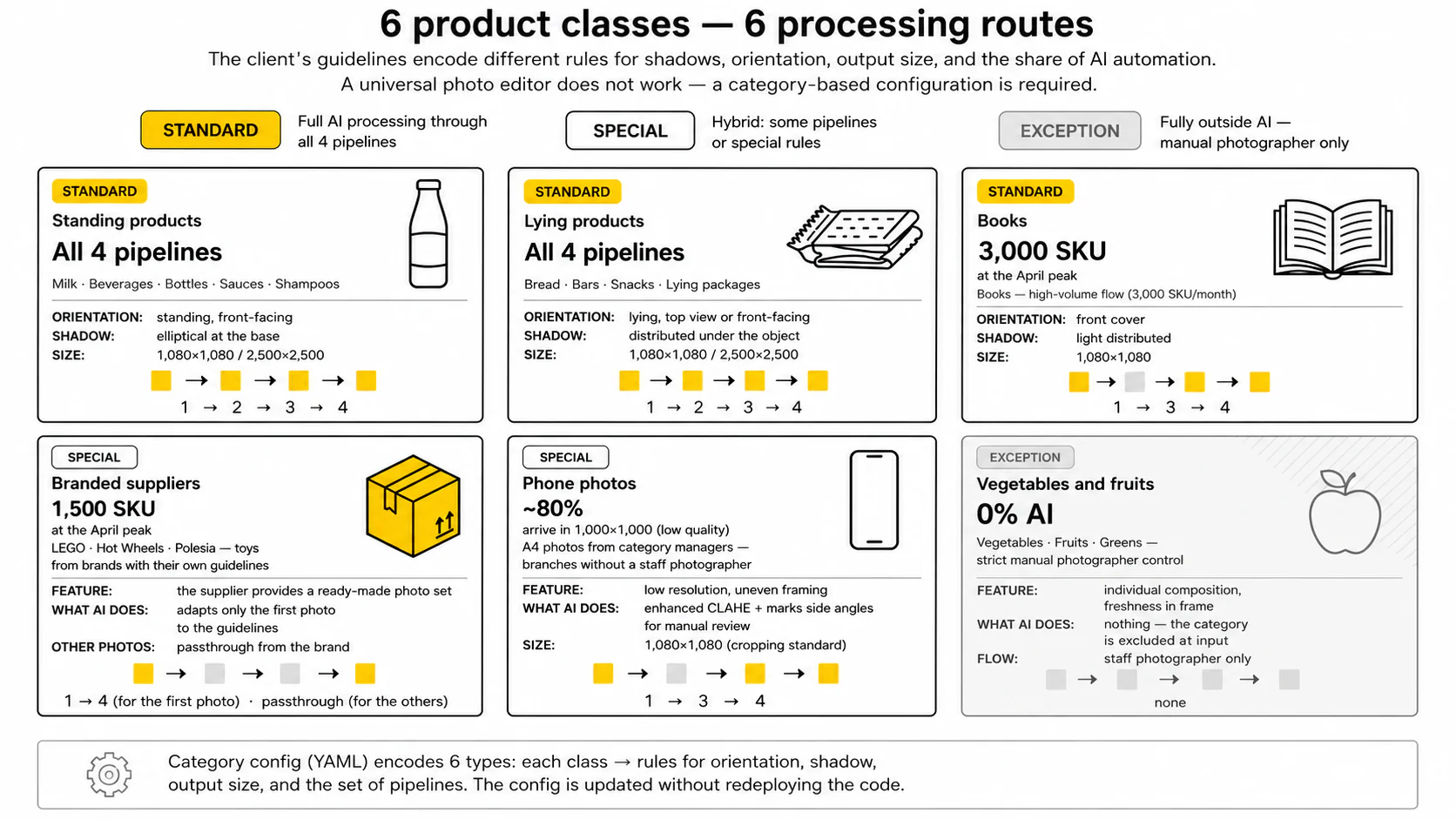
Studio shadow that accounts for product orientation

The system determines orientation from the object mask and applies the appropriate template: an elliptical shadow at the base for upright products (bottle, milk carton) and a distributed shadow for horizontal products (bread, a flat package). The standard is met on every image without designer involvement.

03

Batch of 500+ SKUs and input normalization

Content arrives from 6 sources (Google Drive links, ZIP archives, drag-and-drop, brand databases, phone shots from branches, supplier materials) and is unified into a single stream with naming by barcode or article number. The team no longer works in crisis mode before peak periods.

04

Score-based audit of the existing catalog

A background scan evaluates each photo on 5 parameters (background, insets, angle, shadow, sharpness) and assigns a standard compliance score, forming a prioritized queue: lightweight pipeline, full cycle, or manual review for critical deviations.

AI Catalog Photo Processing — Solution architecture
Solution architecture
AI Catalog Photo Processing — Category routes
Category routes

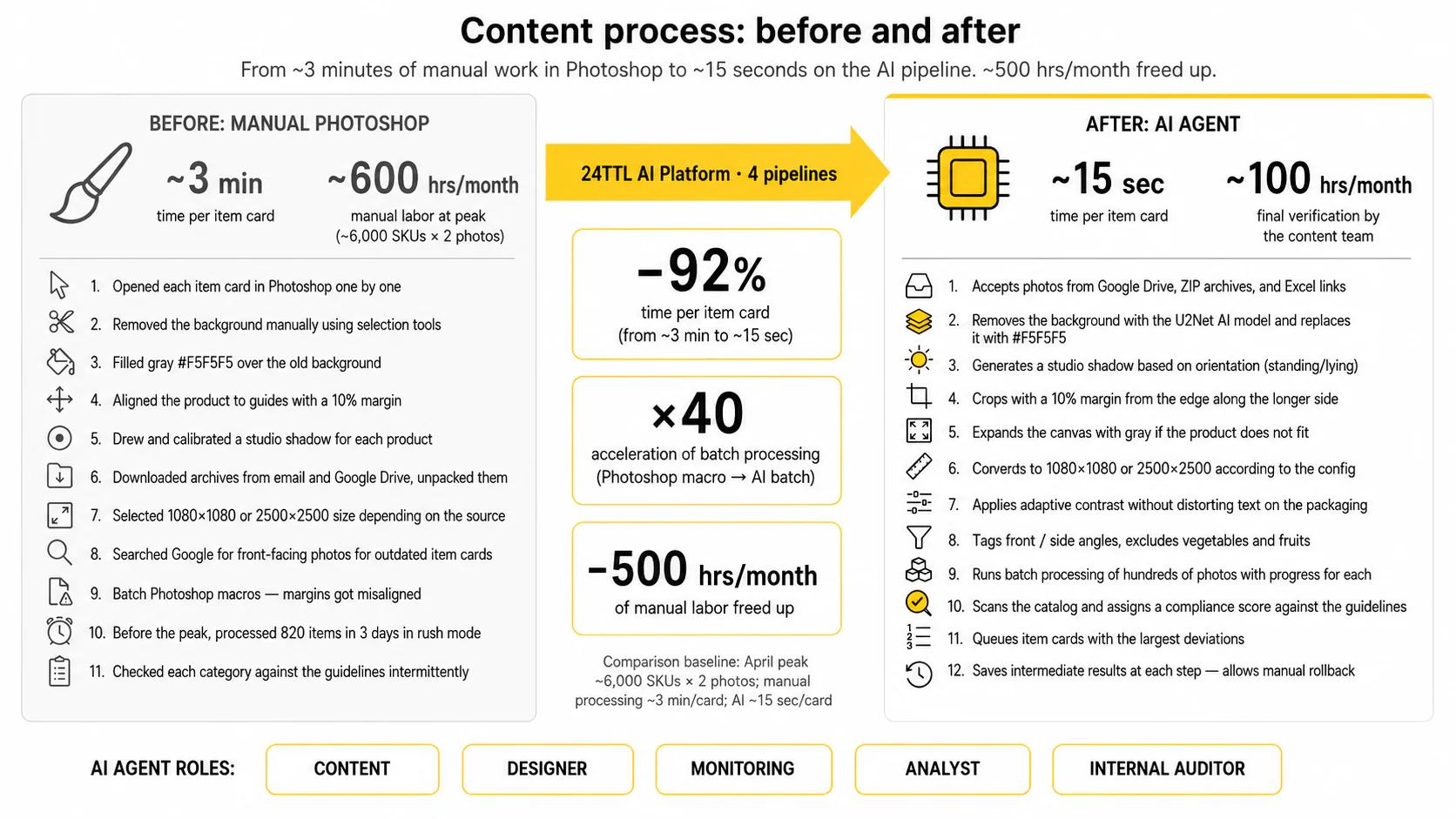
Before and after

Before — manual
  • ×Opened each listing in Photoshop one at a time
  • ×Removed background manually and filled with grey #F5F5F5
  • ×Aligned using guides with a 10% inset
  • ×Drew and calibrated a studio shadow for each product
  • ×Downloaded archives from email and Drive, unpacked, renamed
  • ×Before a peak, processed 820 items in 3 days under crunch
  • ×Worked through categories piecemeal, checking against the standard
Now — AI agent
  • Accepts photos from Drive, ZIP, and Excel links in a single process
  • Removes background with U2Net and fills with #F5F5F5
  • Generates a studio shadow based on orientation (upright/horizontal)
  • Crops with a 10% inset and resizes to target dimensions
  • Applies contrast and sharpening without distorting packaging
  • Excludes vegetables and fruit, flags angles
  • Scans the catalog, assigns a score, and queues items for reprocessing
AI Catalog Photo Processing — Process: before and after
Process: before and after

Results

Technical metrics
  • Background segmentation accuracy (target): 95%+
  • Speed: ~15 seconds per listing through the full pipeline
  • Throughput: 500+ SKUs per batch run
  • 6 input channels; all categories covered except vegetables/fruit
Business metrics
  • Significant share of team working time freed up (with final verification instead of a full manual cycle)
  • Time per listing: ~3 min → ~15 sec (significant acceleration)
  • ~6,000 SKUs of the April peak handled in planned mode
  • 100% of the catalog passes the score audit; critical items go to queue
Strategic impact

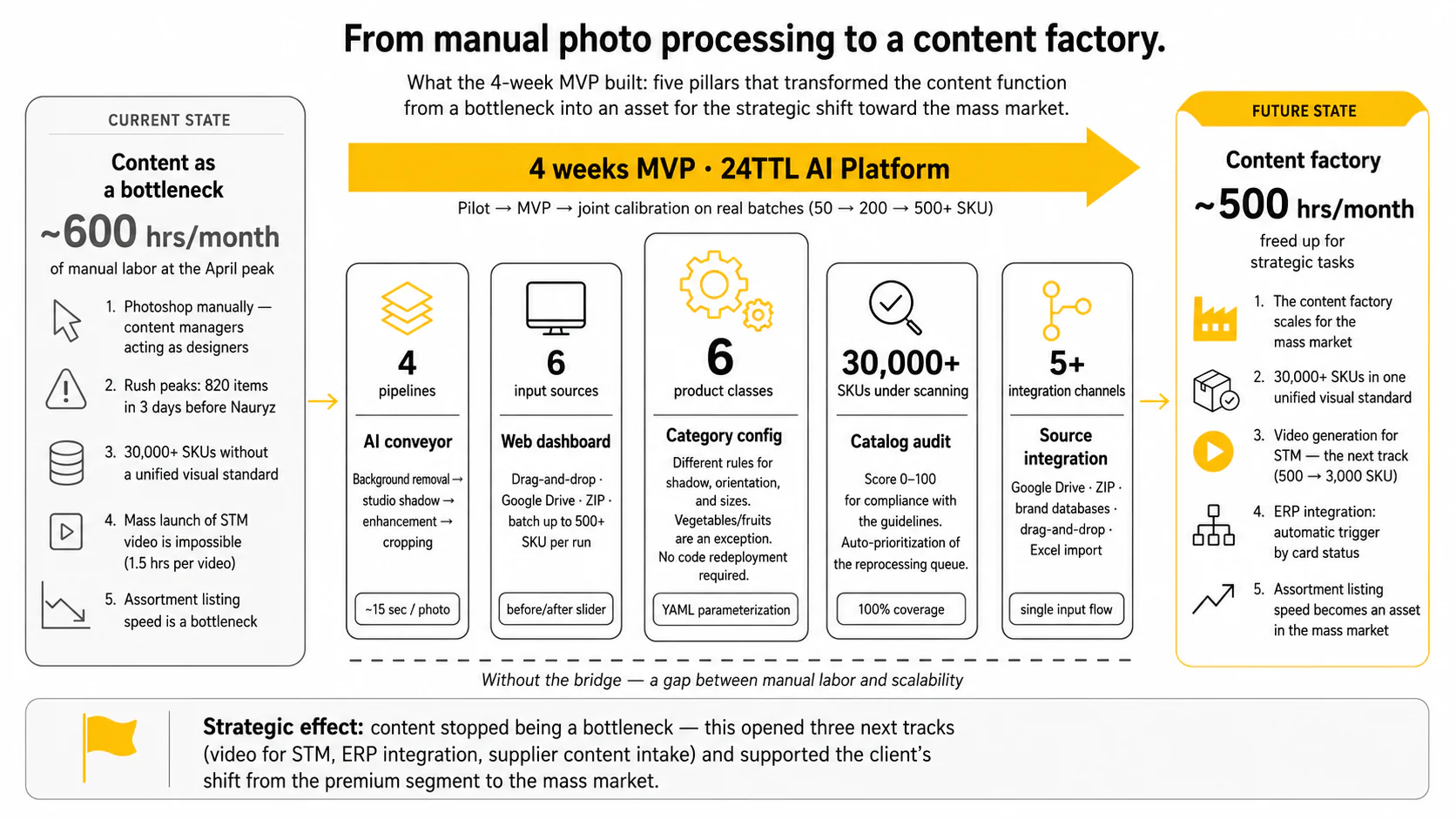
The platform became the automation backbone for the entire content block, not just a photo editor. Tracked next steps include: product videos for private labels, ERP integration by listing status, and automated content intake from suppliers.

The content team is no longer the assortment onboarding bottleneck — this unblocked the client's strategic pivot to the mass market, where new arrival speed competes directly with marketplaces.

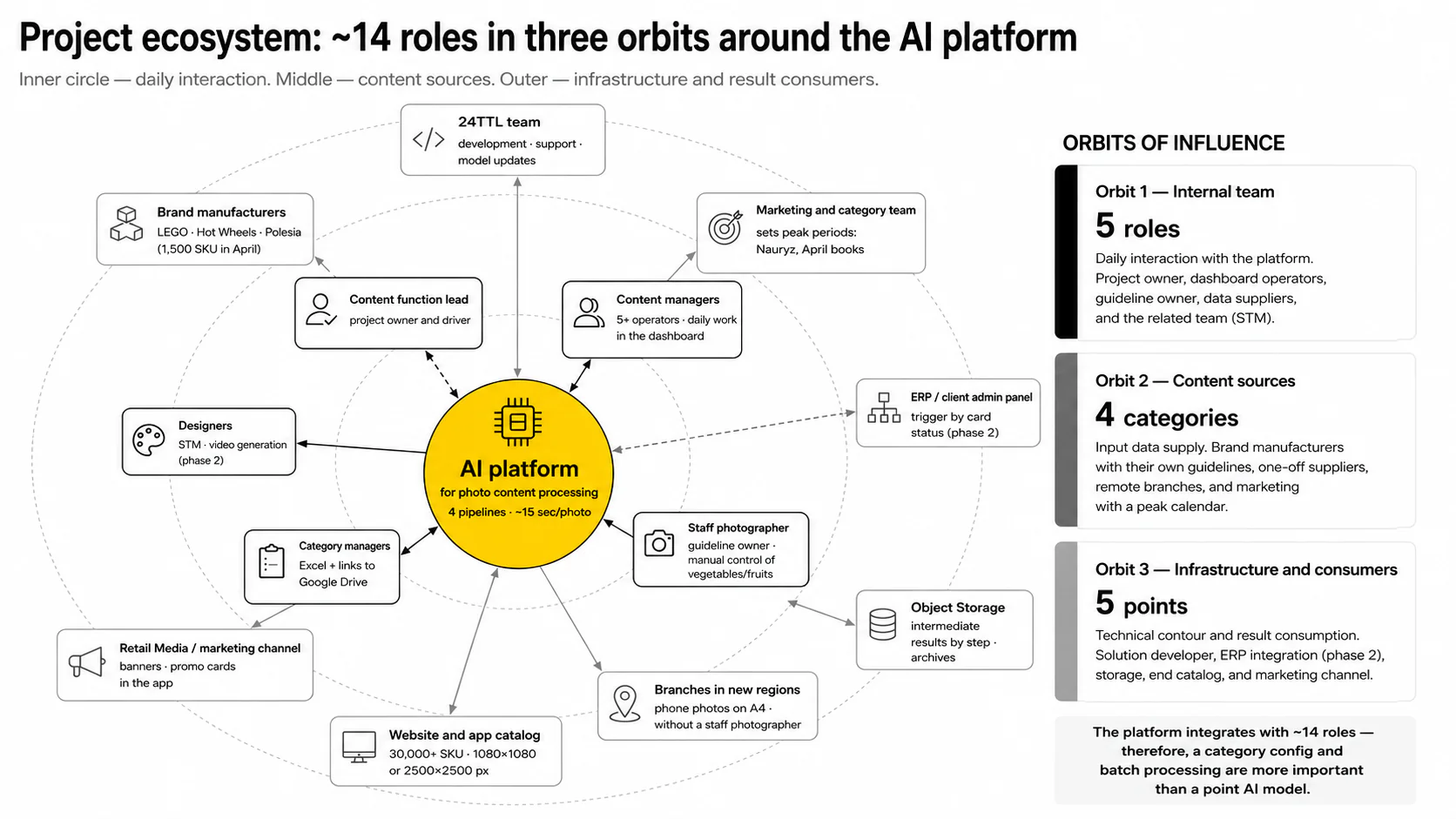
AI Catalog Photo Processing — Ecosystem
Ecosystem
AI Catalog Photo Processing — Now and in the future
Now and in the future
The main pain was not uploading photos, but processing them: we tried running Photoshop at scale, but the guide alignment and insets kept going off every time. Now the standard is applied to every listing automatically, and the team doesn't work in crisis mode before peak periods.
— Head of Content, e-grocery retailer

The metrics and results presented reflect outcomes of a specific project and depend on its initial conditions. They are provided for informational purposes only, do not constitute a public offer, and do not guarantee similar results in other projects. Supporting materials are available on request.

Other cases

Facing a similar challenge?

Tell us about your process — we will suggest an audit, pilot, or full deployment.