Noon Food

How 24.online helped Noon Food standardize a catalog of thousands of restaurant listings: up to 10,000 AI images per week

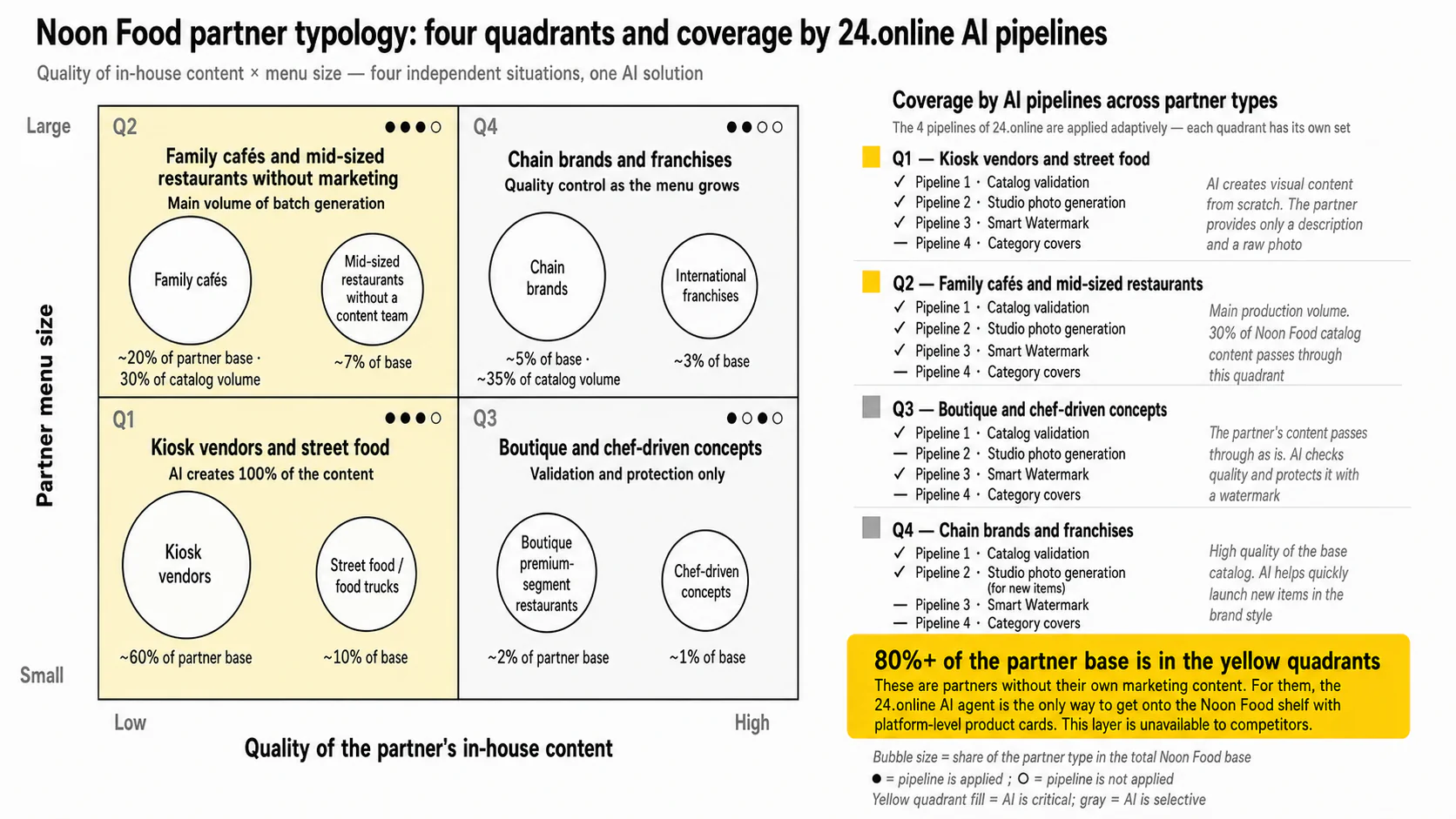
Noon Food competes on catalog quality, but 80%+ of its restaurant partners lack the resources for studio photography. An AI agent orchestrates listing generation and validation — a street stall gets on the shelf on a par with a chain.

Impact High catalog throughput; publication time reduced from days to minutes in select runs
Industry
Food Delivery / Quick Commerce / Restaurant E-commerce
Duration
Audit 2 wks · development & integration 4 wks · retainer
24TTL team
Project Manager, Senior Consultant, AI Engineer, Designer, Frontend Developer, Validation Operator
All cases →
Up to thousands of images per week at peak
Batch processing of up to hundreds of items in a matter of minutes
200+ categories in a unified visual style
EN + AR bilingual validation

Context

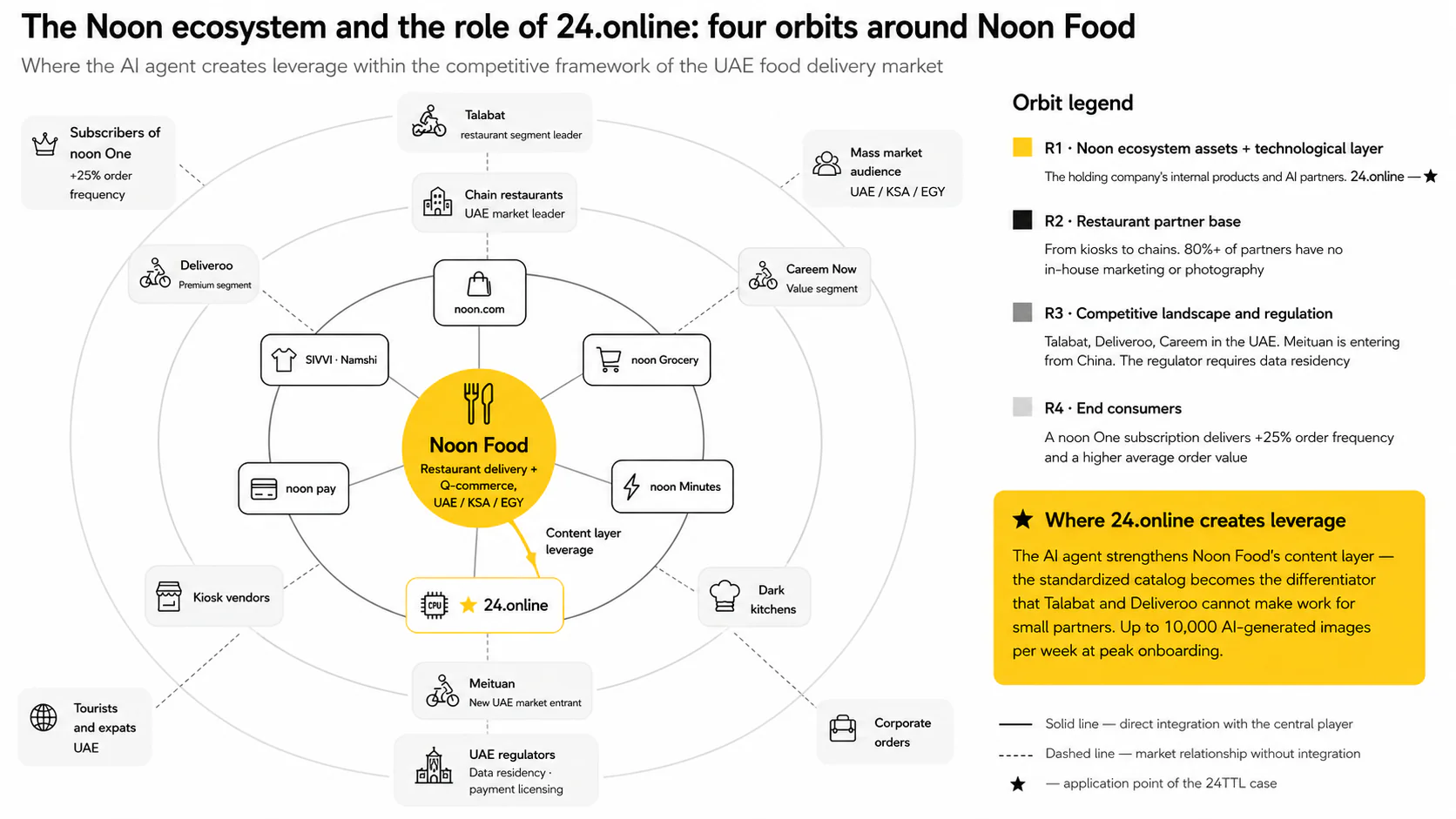
Noon Food is the restaurant delivery and q-commerce unit of the Noon ecosystem (UAE / Saudi Arabia / Egypt). It competes with Talabat, Deliveroo, and Careem on lower commission (23% combined vs. approximately 35% at major competitors) and catalog quality.

The partner base is diverse — from chain brands to family shawarma shops and street stalls. The platform has a unified listing guideline (white background, dish-focused composition, readable in a dense feed), but 80%+ of partners lack the resources for photography.

Challenge

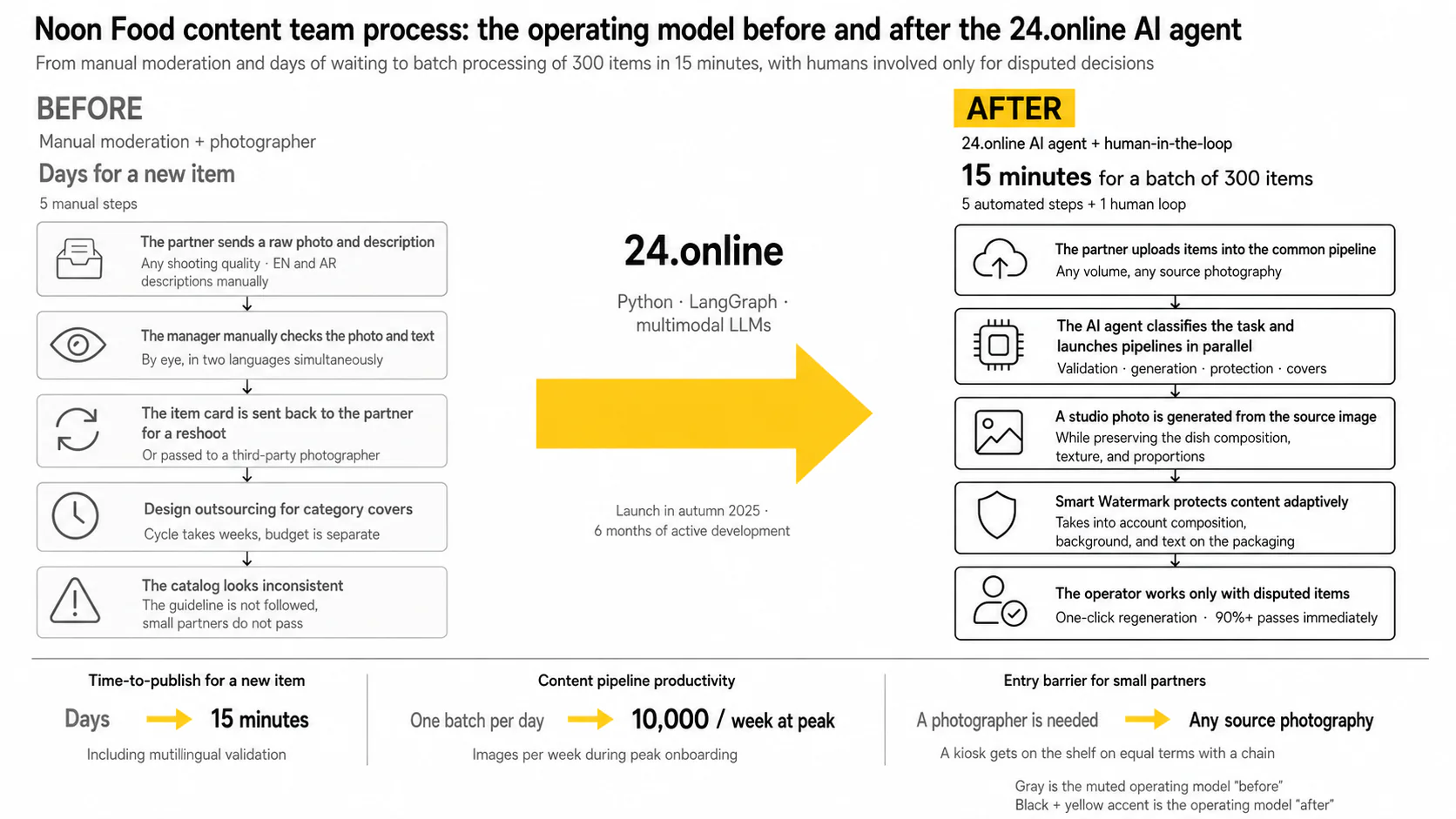
The catalog looked inconsistent: some dishes were on a professional background, others shot from above with a smartphone in poor lighting. The content team manually reviewed every item; some were sent back to the partner for a reshoot, stretching publication time from hours to several days.

The visual codes for Arabic and Middle Eastern cuisine (tableware, garnishes, plating) require their own approach, and off-the-shelf image generation services calibrated for Western food photography did not resonate with the regional audience. Add to that bilingual requirements: every listing must be consistent in both EN and AR simultaneously.

Project goals

What the AI did

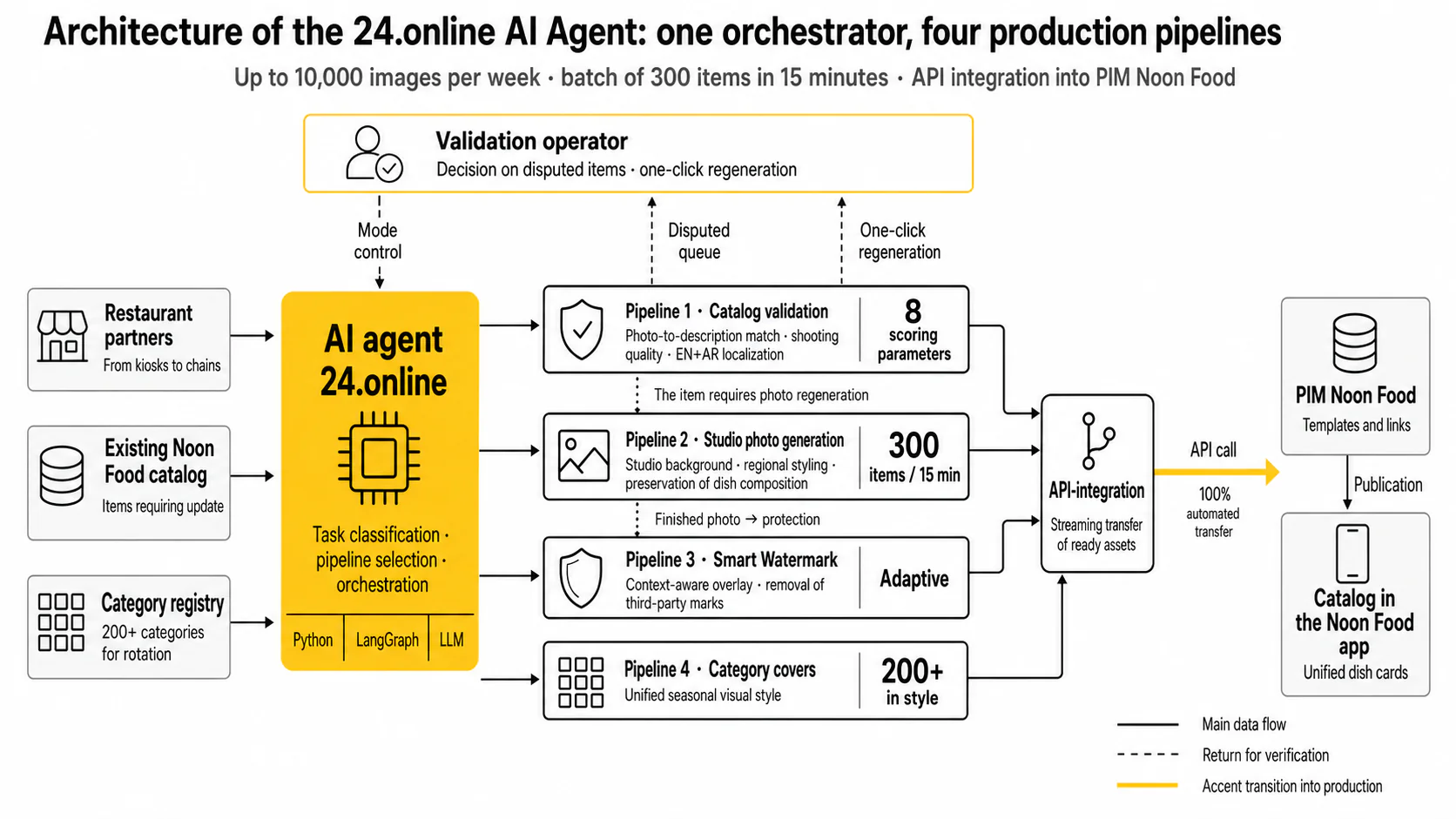
An AI agent orchestrates restaurant listing generation and validation: studio-quality photos from raw shots, bilingual EN/AR validation, and contextual watermarks.

01

Pipeline 1 — incoming catalog validation

The agent scores each item on 8 parameters (photo-text match, crop, sharpness, lighting, background, EN/AR consistency, foreign objects, mobile readability). The multimodal LLM returns a structured JSON, based on which the item is sent to publication, reshoot, or regeneration.
02

Pipeline 2 — studio photo, 300 listings in 15 minutes

The agent takes the original photo as a reference for dish composition and texture, then re-photographs it in a studio composition (white background, branded plate, soft shadow, regional plating codes), preserving the actual dish contents. The "regenerate" button works with a single click.

03

Pipeline 3 — Smart Watermark

The agent analyzes composition and adaptively applies a watermark (position, opacity matched to frame density), and also detects and removes third-party watermarks from external services before processing.

04

Pipeline 4 — category covers

Input: a list of categories. Output: a set of 200+ covers in a unified seasonal visual style. Previously this task was outsourced to design agencies in cycles of several weeks.

05

Transition to API integration within PIM

After six months in web interface mode, the agent was integrated into the PIM via API — batch production became a stream: new items are processed without operator involvement, and the validation operator handles only disputed listings.

AI Catalog Standardization Agent — Solution architecture
Solution architecture
AI Catalog Standardization Agent — Partner typology
Partner typology
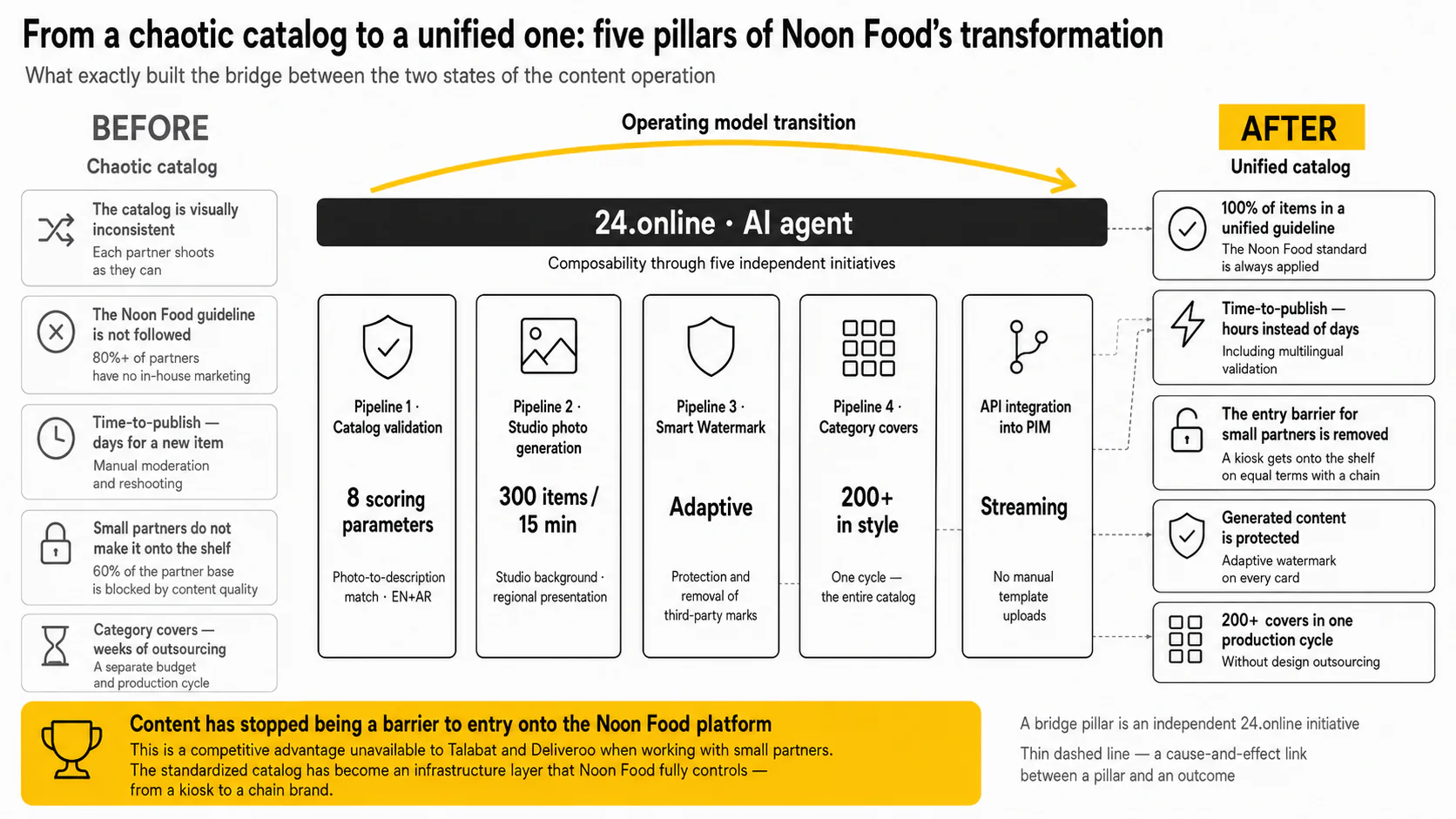
AI Catalog Standardization Agent — Five solution pillars
Five solution pillars

Before and after

Before — manual
  • ×Reviewed every partner photo manually
  • ×Checked EN and AR descriptions side by side by eye
  • ×Sent listings back for reshoot and waited days
  • ×Only worked with partners who had professional photos
  • ×Produced category covers through design outsourcing over weeks
  • ×Applied watermarks using a static template
  • ×Uploaded finalized content to PIM manually
Now — AI agent
  • Scores each item on 8 quality parameters
  • Verifies photo-description semantic match in two languages
  • Re-photographs a dish in studio composition in minutes
  • Brings small partners up to chain-level content quality
  • Produces 200+ category covers in a single cycle
  • Adaptively applies watermarks and removes third-party ones
  • Processes 300 items in 15 minutes and writes to PIM via API
AI Catalog Standardization Agent — Process: before and after
Process: before and after

Results

Technical metrics
  • Up to 10,000 AI images per week at onboarding peak
  • Batch: 300 items in 15 minutes (~20 listings/minute)
  • 200+ category covers in a unified style per cycle
  • Bilingual (EN/AR) validation; API integration with PIM
Business metrics
  • Time-to-publish: 3–5 days → 1–2 hours
  • Share of catalog meeting the guideline: from a third to the overwhelming majority of listings
  • Manual moderation: significant reduction (operator handles disputed items only)
  • Onboarding barrier for small partners effectively eliminated
Strategic impact

Content has ceased to be a barrier to joining the platform: a partner without a photography budget gets on the shelf with the content quality of a chain restaurant. This broadened the assortment base in a segment where Talabat and Deliveroo have no equivalent content layer for small players.

The watermark module protected the generated assets — platform content does not leak to third-party apps without a trace, strengthening Noon Food's negotiating position with exclusive partners.

AI Catalog Standardization Agent — Ecosystem
Ecosystem
We got a tool that took the most labor-intensive part away from the content team — not the creative part, but the operational one. Previously, onboarding a new restaurant took days and was bottlenecked by the quality of their photography. Now we onboard a partner in one day regardless of whether they have a photographer or not.
— Content team, Noon Food

The metrics and results presented reflect outcomes of a specific project and depend on its initial conditions. They are provided for informational purposes only, do not constitute a public offer, and do not guarantee similar results in other projects. Supporting materials are available on request.

Other cases

Facing a similar challenge?

Tell us about your process — we will suggest an audit, pilot, or full deployment.